Centre for Forensic Hope
If you wish to get involved, email enquiries@forensichope.org.uk
We’re live. Welcome.
No one should be defined by
the worst moment of their life.
Welcome to the Centre for Forensic Hope.
Help us to change futures.
What we do
Everything we do flows from a single conviction: that hope is not a luxury — whether someone is in a secure unit or rebuilding life after release. It is a necessity.
Rigorous, co-produced research that builds the evidence base for hope-centred practice. We study what works, publish openly, and advocate for change based on what we find.
Transformative training for professionals working in forensic settings and reintegration services — grounded in evidence, informed by lived experience, and designed to shift culture from the inside.
We place the knowledge of people who have lived through forensic settings or incarceration at the heart of everything we do — as researchers, educators, advisors, and leaders.
Improving lives in forensic settings and for formerly incarcerated people through the advancement of hope.Our mission
Voices from the community
"For the first time, someone asked me what I wanted from my recovery — not just what I needed to do to get out."
"The training changed how I see my role entirely. I came away genuinely believing that every person I work with can build a meaningful life."
"The research gave us the language and the evidence to push back on a culture that had normalised hopelessness. That matters enormously."
You are not your past. You are your future.The founding conviction
Latest from the Centre
Centre Director David Adlington-Rivers has written to the Rt Hon Andy Burnham MP following his appointment as Prime Minister, highlighting the importance of hope in prison, probation and rehabilitation reform.
July 2026
Read more →
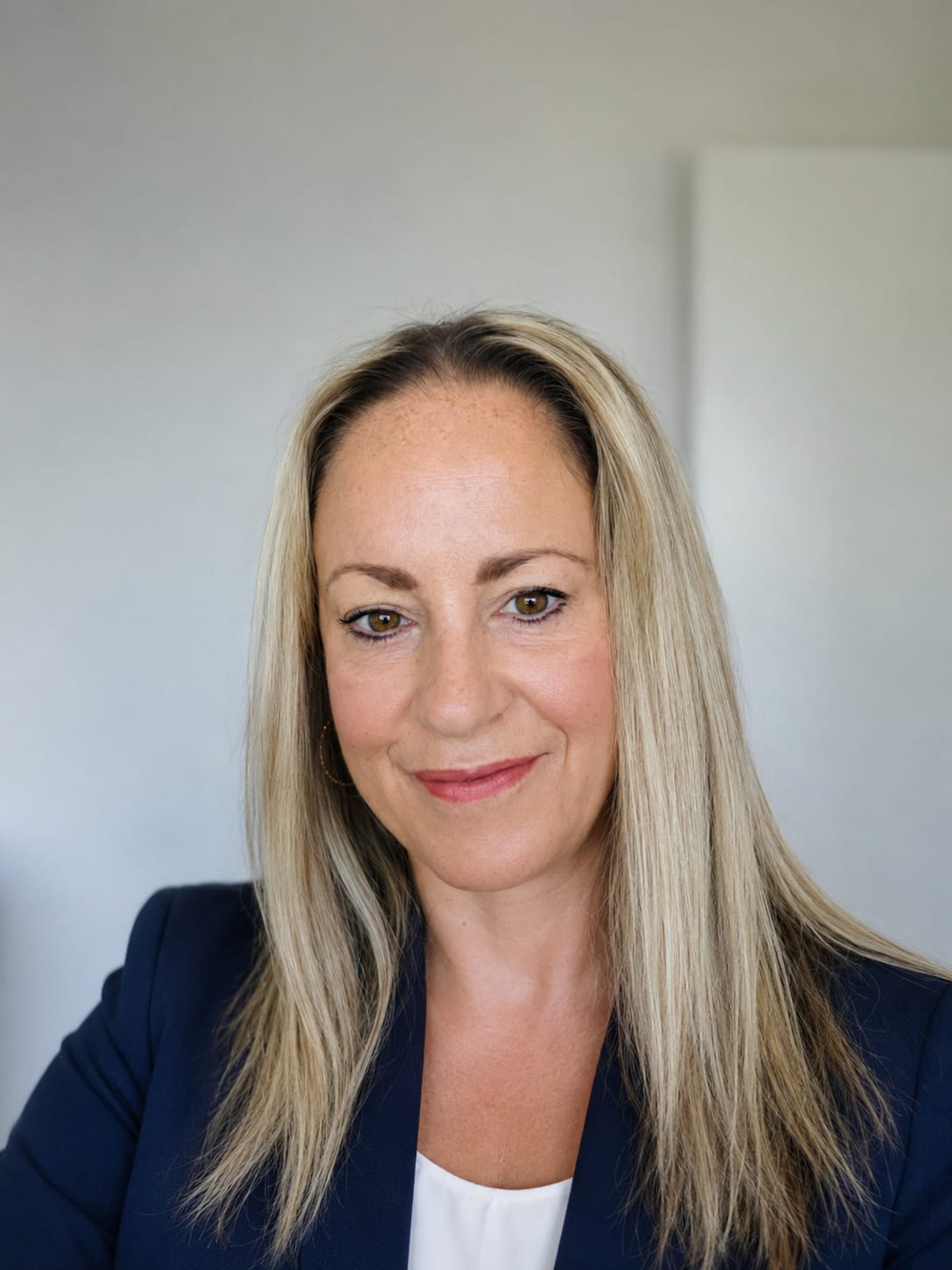
We're delighted to announce the appointment of Caroline Cook to the Centre for Forensic Hope Lived Experience Advisory Group, bringing lived experience, academic study, and cross-sector advisory expertise.
July 2026
Read more →
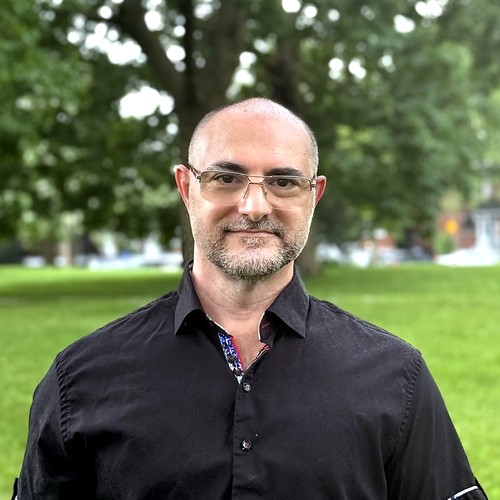
We're delighted to announce the first appointment to the Centre for Forensic Hope Advisory Board — bringing more than 25 years of experience in offender rehabilitation with Correctional Service Canada.
July 2026
Read more →We are a new, independent organisation dedicated to improving the lives of people in forensic settings and formerly incarcerated people — through research, training, and the advancement of hope. This is where it begins.
June 2026
Read more →An independent organisation dedicated to improving lives in forensic settings through research, training, and the advancement of hope.
About Us
The Centre for Forensic Hope is an independent, non-profit making organisation dedicated to improving the lives of people in forensic settings and formerly incarcerated people — through research, education, and the lived experience of those we serve.
We exist because people in forensic settings — and those rebuilding their lives after incarceration — deserve more than containment or exclusion. They deserve the conditions in which genuine recovery becomes possible.
Our values
In forensic settings and post-release life where pessimism can become institutionalised, we actively resist hopelessness. We model, promote, and protect hope as a professional responsibility.
We do not do research about people in forensic settings or those who have been incarcerated — we do it with them. Lived experience is central to our work, not supplementary to it.
We hold ourselves to the highest standards of intellectual honesty, and we are equally committed to translating findings into practice and policy.
We see the full humanity of every person in a forensic setting and every person who has been incarcerated. Dignity is unconditional — it is not something that has to be earned.
We name what we see in the evidence, in the system, in ourselves. Kindness and candour are not opposites.
We are building a Centre where people from forensic settings and the post-release community help design the work — not merely attend it.
Believe what we believe? Membership is a public commitment to hope as a clinical and moral necessity — and a direct investment in the people who most need it.
Become a member → Mission & Values (PDF)"Hope, built together."Centre for Forensic Hope — research, training, lived experience, renewal
Our people
The Centre is built by people who bring scholarship, practice, and lived experience together. We are researchers, clinicians, advocates, and people who have been in forensic settings themselves.
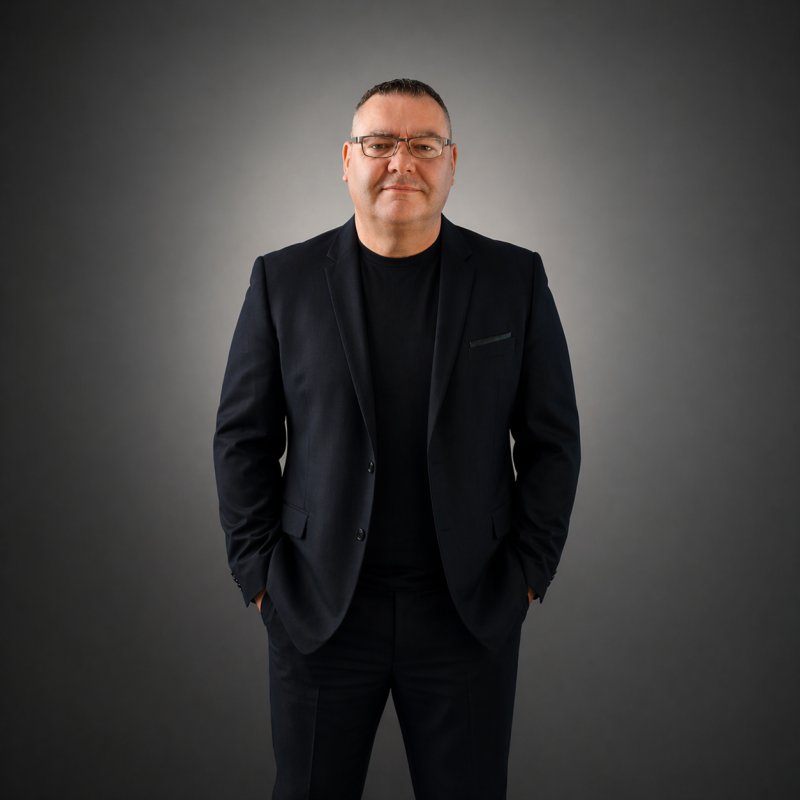
David is an early-career researcher and one of the UK's emerging voices in the application of hope theory to criminal justice. His doctoral research at Durham University explores the lived experience of hope among people released from prison, examining how hope supports desistance and successful reintegration into the community. He is supervised by Professor Tammi Walker — Professor of Forensic Psychology and Principal of St Cuthbert's Society, Durham, whose work spans prison mental health, women in custody, and forensic psychiatric settings — Assistant Professor Leanne Trick (Durham, Department of Psychology), and Associate Professor Jake Phillips of the Institute of Criminology, University of Cambridge, whose research focuses on hope, probation practice, and the intersection of criminal justice policy and desistance. David has lectured in Forensic Psychology for a number of years at Buckinghamshire New University, where he teaches on the BPS-accredited Masters degree. He is the author of Freedom is in the Mind, a self-help book held in prison libraries across the UK including Broadmoor Hospital and HMP Grendon, and has written on hope theory for the Prison Service Journal and The Probation Institute. He is a Full Member of the British Psychological Society and an Academic Member of the Criminal Justice Alliance.
Ron brings more than 25 years of experience in the Canadian federal correctional system, having dedicated the majority of his career to offender rehabilitation, programme delivery, and mental health with the Correctional Service of Canada (CSC). Now retired from CSC, he is completing a Master of Science in Applied Positive Psychology, with academic and professional interests in the therapeutic alliance in correctional settings, hope theory, offender engagement, and strengths-based approaches to promoting lasting behavioural change and reducing recidivism. Ron is passionate about advancing a more compassionate, evidence-based model of corrections — one that recognises the importance of accountability while acknowledging every person's capacity for growth and change; his work reflects a belief that rehabilitation is built on trust, hope, and authentic human connection.
Caroline was involved in the criminal justice system as a result of the interconnected experiences of trauma, mental health difficulties, addiction and homelessness. Her experiences have shaped her understanding of recovery, rehabilitation and the importance of meaningful support. Having rebuilt her life, she is now completing an MSc in Applied Forensic Psychology at Buckinghamshire New University. She contributes to lived-experience teams and advisory panels across the homelessness, addiction, and criminal justice sectors.
Caroline has gained insight into how multiple disadvantages can contribute to offending and how language and stigma influence the way people are understood and responded to. She believes that recovery is possible when people are offered hope, understanding and opportunities to rebuild their lives. She is passionate about ensuring that people are seen as more than their past, recognising the complex experiences and root causes that can contribute to offending.
Working alongside researchers, practitioners and organisations, Caroline contributes to research, policy and practice aimed at improving outcomes for people involved in the criminal justice system. She combines lived experience with academic knowledge to help shape more compassionate, effective and evidence-informed responses that support lasting positive change.
CFH Fellows are academics, researchers, and practitioners who formally affiliate with the Centre — contributing expertise, collaborating on projects, and helping shape the evidence base for forensic hope. Fellowship is an honorary designation conferred by the Centre Director, recognising a sustained commitment to the Centre's mission.
What is a CFH Fellow? ↓About the Fellowship
Awarded to established academics or senior practitioners with a significant body of work relevant to hope, forensic mental health, or criminal justice. Senior Fellows lead or co-lead research projects and contribute to the Centre's academic advisory function.
Awarded to early- and mid-career researchers, clinicians, or practitioners who collaborate with the Centre on defined projects or contribute regularly to its knowledge base. Associate Fellows are active contributors to the Centre's research and training work.
Awarded to doctoral researchers and postdoctoral academics whose work directly advances the evidence base for forensic hope. Research Fellows benefit from Centre affiliation, access to the research network, and co-authorship opportunities.
Fellowship is conferred by resolution of the Board, on nomination by the Centre Director, a current Fellow, a Director, or the Advisory Board. If you believe your work aligns with the Centre's mission and would like to explore affiliation, get in touch →, download the guide for academics →, or read the Fellowship Terms of Reference →
Our structure
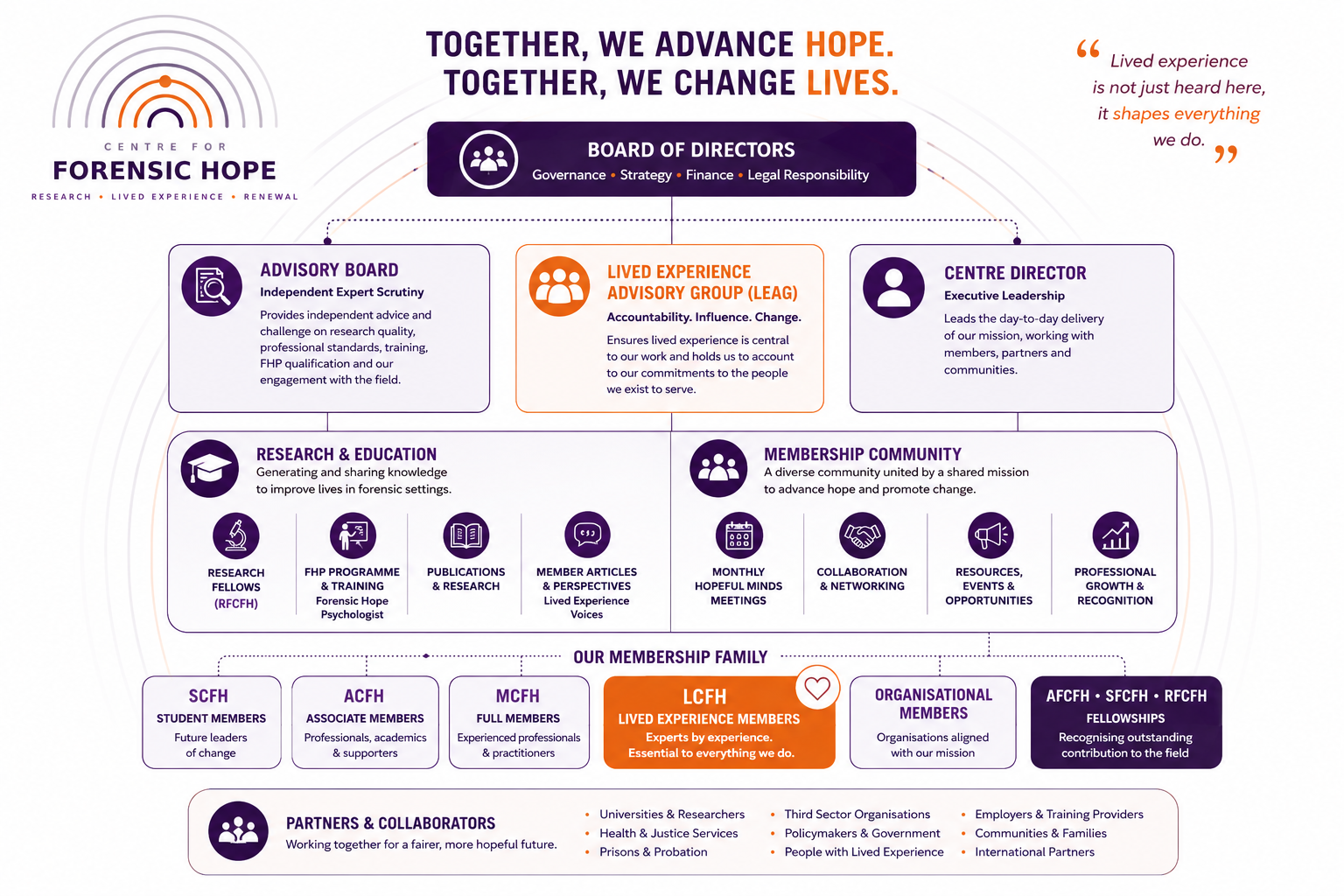
From the Board of Directors down to our membership family and wider partners, every part of the Centre is built to keep lived experience central to what we do.
Tap or click the diagram to open the full-size version — on mobile this opens in your photo viewer, where you can pinch to zoom.
Governance & legal status
The Centre for Forensic Hope is a company limited by guarantee, non-profit making, registered in England and Wales. Its Constitution was adopted by written resolution on 21 June 2026 and governs the Centre's objects, membership, Board, and decision-making.
Centre For Forensic Hope Ltd is a private company limited by guarantee. There are no shareholders. Directors are the guarantee members, each liable for £1 in the event of winding up. Members of the Centre are subscribers — not company members — and bear no liability for its debts.
The Centre is non-profit making by constitution. No income or property may be paid to members by way of profit or dividend. All income is applied solely towards the Centre's objects: advancing hope-focused research, training, and practice in forensic settings.
The Constitution (Version 2.0, adopted 21 June 2026) sets out the Centre's objects, governance structure, membership categories and rights, Board composition, and decision-making procedures. It is freely available to download below.
Registration status
Centre For Forensic Hope Ltd is incorporated at Companies House (company number 17294992). The Constitution was adopted as the Articles of Association by written special resolution dated 21 June 2026 and governs the Centre's objects, membership, Board, and decision-making. The Centre is also registered with the Information Commissioner's Office (ICO) as a data controller, registration reference ZC189227.
Ready to get involved?
Whether as a member, a Fellow, or an organisational partner, there's a place for you at the Centre.
Co-produced research on hope, recovery, and reintegration in forensic and criminal justice contexts.
Research & Evidence
The Centre is new. But the research that underpins it is not. Here is where we are starting from — and where we are going.
Founding research
There is a growing body of evidence on hope in forensic settings and post-release life — from hope theory and desistance research to studies of recovery in secure mental health, probation practice, and reintegration. The Centre draws on and contributes to that evidence base. Central to our founding research programme is doctoral work currently under way at Durham University.
This qualitative doctoral study examines how hope is experienced, lost, and rebuilt among people released from prison — and what that means for desistance, reintegration, and identity reconstruction. Using an interpretive phenomenological approach, the research centres the voices of people who have been through the criminal justice system, asking what hope means to them and how it operates in the difficult months and years after release.
The research is supervised by Professor Tammi Walker — Professor of Forensic Psychology and Principal of St Cuthbert's Society, Durham, whose work spans prison mental health, women in custody, and forensic psychiatric settings — Assistant Professor Leanne Trick (Durham, Department of Psychology), and Associate Professor Jake Phillips of the Institute of Criminology, University of Cambridge, whose research focuses on hope, probation practice, and desistance.
This research sits within a wider field — including the work of scholars such as Shane Lopez, C.R. Snyder, Shadd Maruna, and Jake Phillips — that establishes hope as a measurable, cultivable force in the lives of people in forensic settings and after release. Its findings will contribute directly to the Centre's training programmes, practice guidance, and policy work.
Our approach
The Centre has not yet published independent research — we are honest about that. But we have clear principles for how we will work when we do.
People with lived experience of forensic settings or incarceration will be involved from research design through to dissemination — not consulted at the end. We will not do research about people without doing it with them.
All Centre research will be published openly and without paywall. Evidence that changes practice must reach practitioners. Evidence that changes policy must reach policymakers. Neither should require an institutional subscription.
We are not interested in producing studies that sit in journals and change nothing. Every project will have a clear theory of change — a pathway from finding to practice. If we cannot articulate that, we will not start the project.
Research priorities
These are the areas where we believe the evidence base is weakest, the need is greatest, and the Centre is best placed to contribute.
The evidence that hope matters for recovery is strong. The tools for measuring it in forensic contexts are underdeveloped. We intend to work with NHS England, forensic commissioners, and people with lived experience to develop and validate practical measures that can be embedded in care pathways.
How professionals describe risk has consequences for how people see themselves. We want to examine the relationship between clinical language, ward culture, and the capacity for hope — and what changes when the language changes.
Building directly on the Centre's founding doctoral research — what does hope look like in the post-release period? How is it sustained or extinguished? What can probation, reintegration services, and communities do to support it?
A systematic review of interventions designed to cultivate hope in forensic and criminal justice settings — examining what works, for whom, under what conditions, and why. Designed to give practitioners evidence they can actually use.
Published work
While the Centre is newly established, its Centre Director has already contributed to the evidence base and professional literature on hope in criminal justice contexts.
David Adlington-Rivers' self-help book, held in prison libraries across the UK including Broadmoor Hospital and HMP Grendon. Grounded in hope theory and practical psychology, it is a direct translation of the evidence base into accessible practice for people in custody and after release.
David has written on hope theory and its application in criminal justice contexts for the Prison Service Journal and The Probation Institute — two of the UK's leading professional publications for people working in custody and community justice settings.
An academic or researcher? CFH Fellows formally affiliate with the Centre — contributing to research, co-authoring publications, and helping build the evidence base for forensic hope. Download the guide for academics →
About the Fellowship →Support the research. Membership income funds co-produced studies that build the evidence base for hope-informed practice — and change what happens in real settings.
Become a member →An imagined future
"Research driven. Hope focused. Futures changed."The vision for the Centre for Forensic Hope Research Centre
Want to be part of this?
Academics and researchers can affiliate as CFH Fellows. Everyone else can support the research simply by becoming a member.
Evidence-based training grounded in hope theory, forensic psychology, and the expertise of people with lived experience.
Training & Education
Our training programmes are grounded in evidence, co-facilitated by people with lived experience, and built for the realities of forensic settings and reintegration work. Programmes are opening for booking on a rolling basis — here is what's available now, and what's coming next.
Our approach
Most training changes what people know. We want to change how they think — about the people they work with, about risk, about hope, and about their own role in either extinguishing or sustaining it.
Every programme will be built on the research evidence for hope-informed practice — including the Centre's own founding research on hope and reintegration. We will not teach what feels good. We will teach what the evidence supports.
People who have been in forensic settings or incarcerated will co-facilitate our programmes — not as guest speakers, but as equal training partners. Their knowledge changes what professionals hear and how they hear it.
Forensic settings are complex, under-resourced, and often risk-averse. Our programmes will be designed for the world as it is, not as we wish it were — practical, honest, and applicable the Monday after training.
Our programmes are checked against the latest published research in hope theory, forensic psychology, and desistance before every delivery — not written once and left to date. When the evidence moves, the content moves with it, so what you learn reflects where the field stands now, not where it stood when the course was first built.
Now opening
Our training programmes are launching on a rolling basis, with sessions opening for booking as dates and venues are confirmed. Interest has been strong, and spaces are allocated first come, first served — so we'd encourage booking early once a programme opens. Register your interest now to be notified the moment a course you're interested in goes live, or get in touch to discuss organisational training in advance.
Our flagship programme for professionals working in forensic mental health and reintegration services. Will explore the theory and practice of hope-informed care — working with risk, supporting recovery, and using language that builds rather than diminishes hope. Co-facilitated by people with forensic and post-release lived experience. Planned as a 5-day programme with in-house and open cohort options.
View course detailsA 2-day leadership programme for ward managers, team leaders, and service leads. Will examine how organisational culture shapes individual hope — and how leaders can actively build environments in which recovery is genuinely expected. Includes case study work and peer reflection.
View course detailsA one-day foundation programme for staff who are new to forensic settings, prisons, probation, resettlement, or reintegration services. Introduces the evidence, theory, and practical application of hope-informed practice, with a focus on engagement, motivation, wellbeing, identity, and positive change. Available as an in-house programme or through open-cohort delivery.
View course detailsWe are open to conversations with organisations that want to develop bespoke training tailored to their service, team, and clinical context. If you are planning ahead or seeking to embed hope-informed approaches organisationally, contact us now to begin that conversation.
View course detailsAll training bookings are subject to our Training Terms & Conditions.
Members train for less. CFH members receive discounted member rates on our training programmes.
Become a member →
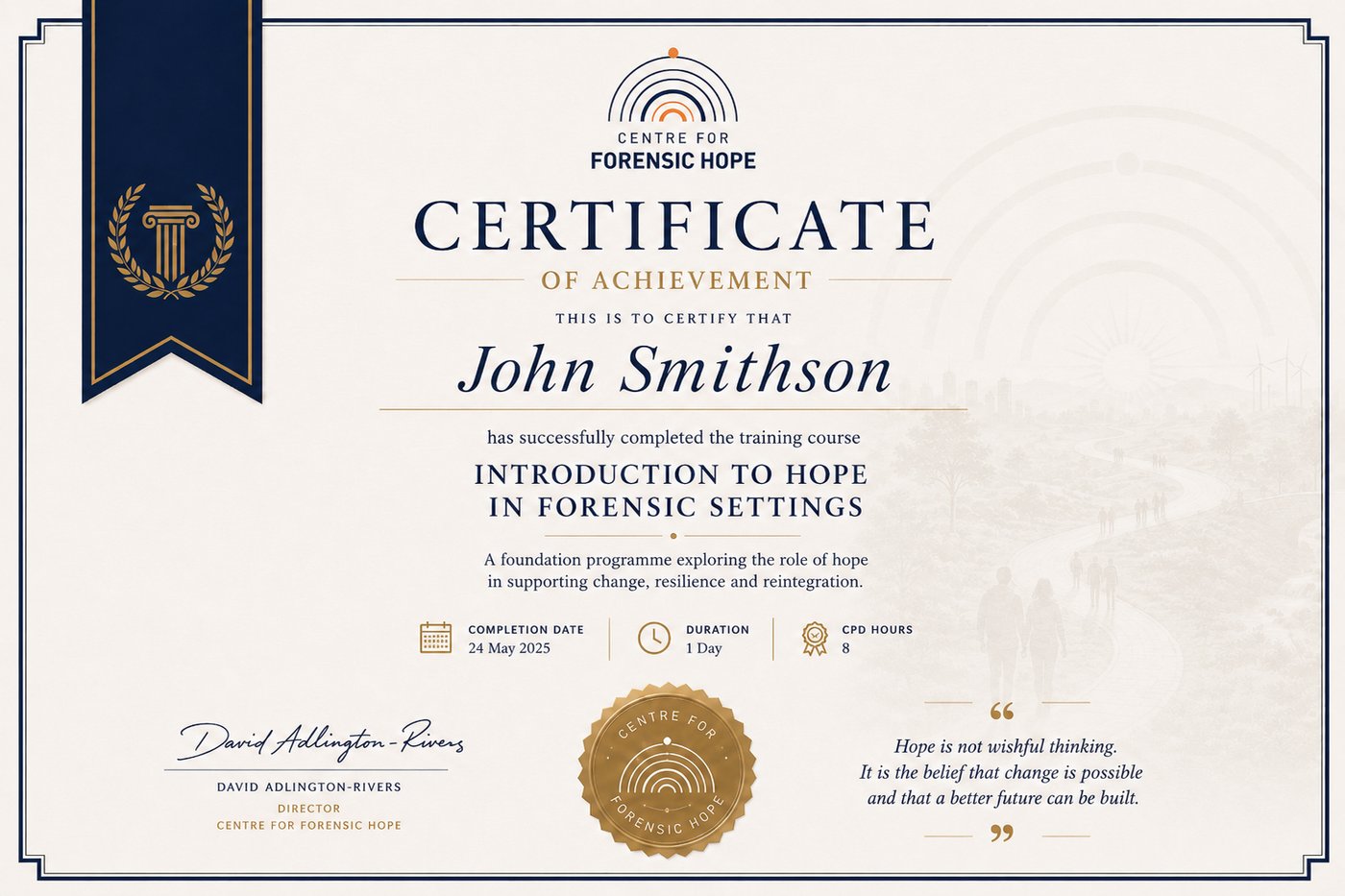
Example certificate — for illustration only
On completion
Every CFH training programme comes with a personalised certificate of achievement — logging your CPD hours and signed by the Centre Director — ready to keep as evidence for your professional portfolio or appraisal.
"Most training changes what people know. We want to change how they think."Centre for Forensic Hope — training philosophy
Accredited qualification
The Centre is developing an accredited qualification for practitioners working at the intersection of hope, forensic psychology, and criminal justice — leading to the professional status of Forensic Hope Psychologist (FHP).
The Forensic Hope Psychologist qualification is designed for practitioners from across forensic mental health, probation, criminal justice, social work, nursing, and allied fields — who want a rigorous, evidence-based framework for hope-informed practice and the professional recognition that comes with it.
The qualification will draw on hope theory, desistance research, trauma-informed practice, and the Centre's own founding research into hope and reintegration. It will be practically orientated, academically rigorous, and co-produced with people who have lived experience of forensic settings.
Full Membership is the pathway to FHP. High demand is expected. Places will be allocated first come, first served based on membership join date — the sooner you join, the earlier your place in the queue.
Join as a Full Member →Our flagship programme for professionals working in forensic mental health and reintegration services.
Course description
Hope-Informed Practice is designed for practitioners across forensic mental health, prisons, probation, and reintegration services who want a rigorous, evidence-based grounding in hope theory and its application to real clinical and custodial decision-making.
The programme explores the theory and practice of hope-informed care — how to work with risk, support recovery, and use language that builds rather than diminishes hope — co-facilitated throughout by people with forensic and post-release lived experience, as equal training partners rather than guest contributors.
It draws on the Centre's own founding research into hope and reintegration, alongside the wider evidence base for hope theory and desistance (Snyder, Maruna, Lopez, Phillips, and others), and is built for the realities of forensic settings: practical, honest, and applicable the Monday after training.
Who it's for
No prior training in hope theory is assumed.
Upcoming open-cohort sessions
| Location | Date | Delivery | Seats available | |
|---|---|---|---|---|
| Manchester | 15–19 September 2026 | In person | Fully booked | Join waitlist |
Learning outcomes
By the end of this programme, participants will be able to:
This session is fully booked. Register your interest to be notified when the next cohort opens, or to discuss delivering this programme in-house for your organisation.
Register interest →A leadership programme for ward managers, team leaders, and service leads.
Course description
Creating Hope-Enabling Cultures is a leadership programme for ward managers, team leaders, and service leads who shape the everyday culture their teams work within.
It examines how organisational and team culture shapes individual hope — for staff and for the people they support — and how leaders can actively build environments in which recovery is genuinely expected, not just permitted.
The programme uses case study work and structured peer reflection, drawing on the same evidence base as Hope-Informed Practice, but applied specifically to questions of leadership, team culture, and organisational behaviour.
Who it's for
Learning outcomes
By the end of this programme, participants will be able to:
This programme is still in development. Register your interest to be notified when dates are confirmed, or to discuss delivering this programme in-house for your leadership team.
Register interest →A one-day foundation programme for staff who are new to forensic settings, prisons, probation, resettlement, or reintegration services.
Course description
A one-day foundation programme for staff who are new to forensic settings, prisons, probation, resettlement, or reintegration services.
The programme introduces the evidence, theory, and practical application of hope-informed practice, with a focus on supporting engagement, motivation, wellbeing, identity, and positive change.
Available as an in-house programme or through open-cohort delivery.
Who it's for
Also a good foundational grounding before progressing to Hope-Informed Practice or Creating Hope-Enabling Cultures.
Upcoming open-cohort sessions
Open-cohort dates, locations, and seats available will be published here once confirmed. Register your interest to be notified as soon as a session is announced.
Learning outcomes
By the end of the programme, participants will be able to:
This programme is still in development. Register your interest to be notified when dates are confirmed, or to discuss delivering this programme in-house for your team.
Register interest →Training tailored to your service, team, and clinical context.
Course description
We are open to conversations with organisations that want to develop bespoke training tailored to their service, team, and clinical context.
Where our three core programmes are fixed in structure, a bespoke programme is built from the same evidence base and co-facilitation model, but shaped around your organisation's specific setting, workforce, and priorities — whether that is a particular type of forensic service, a specific stage of the reintegration pathway, or a defined organisational challenge.
Because the exact content is developed with you, this page describes the process and what you can expect, rather than a fixed syllabus.
Who it's for
Any organisation planning ahead, or seeking to embed hope-informed approaches organisation-wide, rather than through a single open programme.
What we can build with you
Every bespoke programme is different, but conversations typically explore how we can help your organisation to:
Ready to start the conversation? Get in touch to discuss what a bespoke programme could look like for your organisation.
Get in touch →The expertise of people who have been in forensic settings or who have been incarcerated is foundational — not supplementary.
Lived Experience
We believe the expertise of people who have been in forensic settings or who have been incarcerated is foundational — not supplementary. Here is how you can be part of what we do.
Lived experience researchers, advisors, and educators are paid, credited, and central to everything we produce. We are committed to genuine co-production — which means involving people from the very beginning, not consulting at the end.
Get involved"No one should be defined by the worst moment of their life."The founding conviction of the Centre for Forensic Hope
When our first research projects launch, we will be recruiting people with direct experience of forensic settings or incarceration to join the research teams as co-researchers. Full training and support will be provided. All roles will be paid. We will announce opportunities here and to members first.
Join to hear first →When our training programmes launch, we will recruit people with lived experience of forensic settings or incarceration to co-facilitate alongside professional trainers. Your presence in the room changes what professionals hear and how they hear it. Opportunities will be advertised to members first.
Join to hear first →Our LEAG will shape the strategic direction of the Centre — advising on research priorities, training content, policy positions, and organisational culture. Members are paid, supported, and genuinely influential. We are forming the group now.
See the LEAG role →The Forensic Hope Forum will be a dedicated online community for Centre members — a space for researchers, practitioners, and people with lived experience to connect, share, and shape the movement for forensic hope together. Launching for members soon.
Become a member →Join the LEAG
The LEAG is the body that holds the Centre accountable to its commitments to people with lived experience — from the inside. LEAG members advise the Board directly on whether the Centre’s practices, language, research design, training, and governance are genuinely working for the people it exists to serve. This is not a consultation panel. The LEAG Chair sits at the Board table and the Board must respond in writing to every formal LEAG recommendation.
Membership is open to current Lived Experience Members (LCFH) of the Centre. LEAG members are remunerated. We are forming the group now — if you hold LCFH membership and are interested, we want to hear from you.
What the role involves, who we are looking for, what we offer (including remuneration and accessibility support), tenure, and how to express interest. No formal application required.
The full constitutional terms — composition, appointment, tenure, remuneration, the Chair’s reporting relationship to the Board, and how the LEAG relates to the Advisory Board.
LCFH members only — or write to enquiries@forensichope.org.uk
Join the Advisory Board
The Advisory Board provides independent expert scrutiny of the Centre’s research, professional standards, and FHP qualification. We are looking for people with direct lived experience of forensic settings or incarceration to join alongside academics and practitioners — lived experience is a constitutional requirement of the Advisory Board, not an afterthought.
Terms of reference including purpose, composition, appointment process, tenure, remuneration, and the Advisory Board’s distinct role alongside the LEAG. No formal application form required.
To express interest, write to enquiries@forensichope.org.uk
NHS trusts, voluntary sector providers, probation services, social work teams, legal organisations, and academic departments — one membership, your whole team.
Organisational membership
Organisational membership of The Centre for Forensic Hope gives your team access to the evidence base, the professional community, and the training they need to embed hope-focused practice — at a single annual fee.
Already part of the Centre
Who it’s for
Organisational membership is designed for any organisation whose staff regularly work with people in forensic settings or in post-release reintegration — and who want to do that work better. That includes:
Forensic mental health units, secure hospitals, medium and low secure services, prison healthcare teams, and independent sector providers including Elysium, Priory, and St Andrew’s Healthcare. Clinical staff in these settings access hope-focused CPD, Hopeful Minds meetings, and the FHP qualification pathway.
Charities and social enterprises working in prisons, with people on probation, or in reintegration — including organisations delivering resettlement, housing, employment, and mentoring services. The Centre’s evidence base and training are designed for the realities of under-resourced, high-pressure forensic environments.
Organisations delivering probation services, community sentences, approved premises, and through-the-gate provision. Hope-informed practice is directly relevant to desistance work, risk assessment, and supporting people through the difficult first months after release.
Local authority and independent social work teams, occupational therapy services within secure settings, and nursing teams in prisons and secure hospitals. The Forensic Hope Psychologist qualification is designed for practitioners across these professions — not only psychologists.
Departments of criminology, forensic psychology, clinical psychology, social work, and law — and research institutes and think tanks working at the intersection of justice and mental health. Organisational membership signals commitment to hope-focused research and gives staff access to the Centre’s network and evidence base.
Criminal defence firms, legal aid chambers, and advocacy organisations whose staff regularly engage with people in forensic settings and post-release. Understanding hope as a clinical and evidential concept is increasingly relevant to legal practice in this space.
Why it matters
Forensic settings are under scrutiny. HMIP, CQC, and HM Inspectorate of Prisons all look for evidence of rehabilitative culture, person-centred practice, and meaningful engagement with the people in services’ care. Hope-focused, evidence-based practice is directly relevant to these frameworks — and increasingly expected.
Your staff need CPD that is grounded in evidence and directly applicable to their work. The Centre’s training programmes and the FHP qualification are designed for practitioners — not academics. Membership gives your team access now, and priority access to new programmes as they launch.
Inspectors want to see that your organisation’s practice is grounded in evidence. The Centre’s research programme — built on hope theory, desistance, and trauma-informed practice — gives your staff and leadership the conceptual framework and the evidence base to demonstrate this.
Co-produced training and genuine partnerships with people with lived experience are now an expectation in commissioning and inspection. The Centre embeds lived experience at every level — and your staff will train and work alongside a community where that is the norm, not the aspiration.
What’s included
One organisational membership covers up to 10 named staff as Full Members of the Centre. Each named member receives the full individual Full Member benefits — including post-nominal letters (MCFH) and the FHP qualification pathway.
Common questions
Yes. Named staff can be updated through your organisational dashboard. The total number of named members cannot exceed 10 at any one time.
No. Organisational membership is open to organisations based anywhere. Named staff members can be based anywhere in the world.
Contact us at enquiries@forensichope.org.uk to discuss. We can talk through options including additional named member slots or enterprise arrangements for larger organisations.
Yes, if your work brings you into contact with people who have forensic histories or who are navigating post-release life. Many of our organisational members will work across custodial and community settings. The key question is whether hope-focused, evidence-informed practice is relevant to what your staff do.
Yes. Contact us at enquiries@forensichope.org.uk and we will arrange an invoice for your finance team. This is available for organisational memberships.
Write to us at enquiries@forensichope.org.uk. We are happy to answer questions, arrange a conversation with the Centre Director, or discuss what membership could look like for your specific organisation before you commit.
Ready to get involved?
To express interest in the Advisory Board, write to us directly. Tell us about your background and what draws you to the Centre's work.
Email us to express interestRegister interest
Tell us a little about yourself and your interest in joining the LEAG. There is no formal application and no minimum length. We will be in touch within seven days.
From founding doctoral research to a fully established Centre — a roadmap built with rigour, lived experience, and hope at every stage.
Projects
The Centre is in its founding year. Here is where we are, where we are going, and the projects we are developing to advance forensic hope in research, training, and practice.
Our journey
From the formation of Centre for Forensic Hope to a fully fledged legal institution — built with rigour, lived experience, and hope at every stage.
Establishment of Centre for Forensic Hope by David Adlington-Rivers, grounded in doctoral research at Durham University. Development of the founding mission, values, and brand identity. Appointment of the Centre Director. Governance framework, constitution, and membership structure created. Website launched.
Recruitment of the Advisory Board and Lived Experience Advisory Group. Launch of membership. Development of the first training resources and practice materials. Scoping of services to support people leaving prison. First commissioned research partnerships under development.
Delivery of the inaugural Hope-Informed Practice training programme. Launch of an open-access resource library for practitioners and people leaving prison. Commission of the Centre's first independent co-produced research project. First policy engagement and publication of the inaugural CFH Symposium.
Launch of the accredited Forensic Hope Psychologist (FHP) qualification and establishment of the Forensic Hope Practitioner role — a new professional standard for practitioners working at the intersection of hope, forensic psychology, and criminal justice. Application for PSA Accredited Register status. Expansion of training nationally and deepening of partnerships with NHS trusts, probation services, and reintegration organisations.
Centre for Forensic Hope becomes a fully established legal institution — independently recognised, financially sustainable, and genuinely co-produced with the people it serves. A body where lived experience of forensic settings leads research, designs training, and shapes policy. Where the Forensic Hope Practitioner is a recognised professional standard. Where hope in forensic settings is not an aspiration but an expectation.
In development
Centre for Forensic Hope is a new organisation. We are not going to pretend otherwise. What we have is a Centre Director with serious academic credentials, a clear evidence base, a principled mission — and the determination to build something that has not properly existed in the UK before. Here is what is genuinely underway.
A substantial body of evidence already exists on hope in forensic settings — from Snyder's hope theory and Maruna's desistance research to emerging work on hope in probation, secure mental health, and reintegration. The Centre is built on that wider evidence base, and contributes to it through original research.
A central part of that contribution is doctoral research being conducted by David Adlington-Rivers at Durham University, examining how hope is experienced, lost, and rebuilt among people released from prison — and what that means for desistance, reintegration, and identity. Supervised by Professor Tammi Walker (Durham), Assistant Professor Leanne Trick (Durham), and Associate Professor Jake Phillips (Institute of Criminology, Cambridge), this research will inform the Centre's training programmes, practice guidance, and policy work alongside the broader field.
About our research →Our flagship training programme for professionals in forensic mental health and reintegration services is in design. It will be grounded in the evidence base, co-designed with people who have lived experience, and built for the real conditions of forensic work. We are currently developing the curriculum and identifying co-facilitators. Delivery planned for 2026.
About our training →We are establishing a standing Lived Experience Advisory Group — a body of people with direct experience of forensic settings or incarceration who will co-design and govern the Centre's work. This is not a consultation panel. LEAG members will have genuine authority over how we research, train, and engage. Recruitment is beginning now.
Find out more →We are building an Advisory Board that brings together academics, clinicians, practitioners, and people with lived experience. Initially appointed by the Centre Director for 12-month terms, extendable by election of the membership, the Board will provide strategic oversight and challenge. Several positions remain open.
Meet the team →We are scoping the Centre's first independent research project — co-produced from the outset with people who have lived experience. The focus will be on hope as a measurable outcome in forensic and post-release settings. We are identifying partners, methodology, and funding. If your organisation would like to be involved, we would welcome the conversation.
Get in touch →We plan to hold the first annual Centre for Forensic Hope Symposium in 2026 — bringing together researchers, practitioners, policymakers, and people with lived experience for a day of genuine conversation, evidence, and commitment to change. Date, venue, and theme to be confirmed. Register your interest now.
Register interest →From 2027, we intend to publish an annual report on the state of hope in forensic settings and post-release life across the UK — drawing on research, practitioner data, and lived experience testimony. The report will be designed to inform commissioners, policymakers, and practitioners, and will be freely available to all.
Our research priorities →Help us build this. Membership income funds the research and projects that change things for people in forensic settings and after release. The sooner we grow, the sooner the work begins.
Become a member →An imagined future · 2029 and beyond
"Where hope is not an aspiration but a standard."The long-term vision of the Centre for Forensic Hope
Policy documents, guides, and publications from the Centre. Some resources are available to all; others are for members only.
Resources
Policy documents, guides, and publications from the Centre. Some resources are available to all; others are for members only.
Public documents
The following documents are freely available to download. No membership required. Document library updated 22 June 2026.
The founding mission, values, and conviction of Centre for Forensic Hope — including our charter of commitments to people with lived experience and the role of the Lived Experience Advisory Group. Version 2.0, June 2026.
A complete guide to the Forensic Hope Psychologist (FHP) qualification — what it is, who it's for, the pathway from Full Membership, and the Centre's intention to seek PSA Accredited Register status. Version 1.0, July 2026.
A guide for academics and researchers interested in getting involved — the Centre's founding research, research priorities, and the routes to affiliate: CFH Fellowship, the Advisory Board, and Organisational Membership. Version 1.0, July 2026.
The governing document of Centre for Forensic Hope — objects, governance, membership structure, member decision-making rights, and amendment procedures. Adopted 21 June 2026. Company number: 17294992. Version 2.0.
The standards every member agrees to uphold — including the Centre's zero-tolerance position on discrimination or harassment against people with lived experience. Version 1.0, June 2026.
The purpose, composition, appointment, tenure, and responsibilities of the Advisory Board — which provides independent expert scrutiny of the Centre’s research quality, professional standards, FHP qualification, and engagement with the wider field and policymakers. Version 1.0, June 2026.
What Advisory Board membership involves, what we are looking for, what we offer, and how to express interest. A lived experience seat is available now.
The purpose, composition, appointment, tenure, and responsibilities of the LEAG — which holds the Centre accountable to its commitments to people with lived experience of forensic settings, reporting directly to the Board. Open to Lived Experience Members (LCFH). Version 1.0, June 2026.
What LEAG membership involves, remuneration, accessibility commitments, and how to express interest. Open to Lived Experience Members (LCFH). Now recruiting.
The categories, nomination and conferral process, membership conditionality, and expectations of the Centre's Fellowship (Associate Fellow, Senior Fellow, and Research Fellow) — a college of senior members conferred by Board resolution in recognition of contribution to the field. Version 1.0, July 2026.
How we collect, use, and protect your personal data — including specific and absolute protections for people with lived experience of forensic settings. Registered with the ICO, reference ZC189227.
Written resolutions adopting the Constitution (v2.0) as Articles of Association — the special resolution of the sole member and the written resolution of the sole Director. Passed 21 June 2026. For retention with statutory records.
All merchandise sales help fund our work and will provide benefits to the people we exist to help.
Member resources
The following documents are available to Centre members. Sign in to access them.
A complete guide to your membership — tiers, benefits, post-nominal letters, your rights as a member (including binding votes and member-elected Director), Hopeful Minds meetings, and the pathway to Forensic Hope Psychologist status. Version 1.3, June 2026.
The annual report on hope in forensic settings and post-release life across the UK. Members receive early access before public release. First edition planned for 2027.
Not a member? Join the Centre to access member resources, the annual report, and the Forensic Hope Forum.
Become a member →Shop
All merchandise sales help fund our work and will provide benefits to the people we exist to help.
Now available
Wear your support. The first item in our small range of merchandise — more is planned as the Centre grows.
SKU: CFHTLE01 · Colour: Navy Blue · Sustainably sourced fabric · Includes UK postage
A soft, premium-weight t-shirt in navy blue, made from sustainably sourced fabric — part of a limited run. The front carries an original artwork of a path toward a hopeful horizon; the back reads “Futures Changed. Lives Rebuilt. Hope. Practice. Possibility.” Available in sizes Small to XX-Large. Price includes UK postage.
Select your size at checkout.
Buy now — £40 →Secure checkout via Stripe. Delivery within the UK is included. For international orders, please email enquiries@forensichope.org.uk.
All merchandise sales help fund our work and will provide benefits to the people we exist to help.
Research updates, policy commentary, programme news, and perspectives from our community.
News & Insights
As we grow, this is where you will find research updates, policy commentary, programme news, and perspectives from our community. For now — we are just getting started.
The Founder and Centre Director of the Centre for Forensic Hope, David Adlington-Rivers, has written to the newly appointed Prime Minister, the Rt Hon Andy Burnham MP, to congratulate him on taking office and to highlight the importance of hope in prison, probation and rehabilitation reform.
Andy Burnham became Prime Minister on 20 July 2026. In his first address from Downing Street, he spoke about restoring hope and investing in people's success rather than continuing to pay for failure — messages that closely reflect the mission and values of the Centre for Forensic Hope.
In his letter, David introduced the Centre as a non-profit organisation dedicated to improving lives across forensic and criminal justice communities through hope-informed research, education and practice. He also explained how lived experience sits at the heart of the Centre's work.
David outlined his doctoral research in forensic psychology at Durham University, which explores how people experience hope following release from prison and how hope can support rehabilitation, desistance and successful reintegration into the community.
The letter also recognised that successive governments have struggled to resolve the long-standing pressures affecting prisons and probation. These include overcrowding, rising demand, limited resources and the complex practical and social barriers faced by people leaving prison.
Council of Europe figures recorded approximately 141 prisoners per 100,000 people in England and Wales in January 2025, compared with a European median of 110. England and Wales therefore continues to imprison substantially more people proportionately than many comparable Western European countries.
David said:
"Hope must be more than a political message. It can become a practical and evidence-informed foundation for helping people move beyond offending, develop meaningful goals and build realistic pathways towards a different future.
"A renewed approach to rehabilitation could reduce reoffending, create safer communities and ease pressure on an overcrowded prison system. This is not about being softer on crime — it is about being more effective at supporting lasting change."
The Centre believes that hope-informed practice can complement accountability and public protection by helping people develop agency, purpose, supportive relationships and an identity beyond their previous offending.
However, hope cannot be created through words alone. It must be supported by credible opportunities, including access to suitable housing, employment, education, treatment, positive relationships and consistent professional support.
David invited the Prime Minister, his advisers and the relevant ministerial teams to discuss the ideas emerging from his research and the developing work of the Centre.
The Centre for Forensic Hope welcomes the Government's emphasis on restoring hope and believes this creates an important opportunity to consider how hope can be embedded within prisons, probation, rehabilitation and resettlement.
By adopting a new, hope-informed approach, the Government has an opportunity to improve individual outcomes, reduce reoffending and help create a more sustainable and effective criminal justice system.
Announcement
July 2026
We're delighted to announce the appointment of Caroline Cook to the Centre for Forensic Hope Lived Experience Advisory Group (LEAG).
Caroline was involved in the criminal justice system as a result of the interconnected experiences of trauma, mental health difficulties, addiction and homelessness. Her experiences have shaped her understanding of recovery, rehabilitation and the importance of meaningful support. Having rebuilt her life, she is now completing an MSc in Applied Forensic Psychology at Buckinghamshire New University. She contributes to lived-experience teams and advisory panels across the homelessness, addiction, and criminal justice sectors.
Caroline has gained insight into how multiple disadvantages can contribute to offending and how language and stigma influence the way people are understood and responded to. She believes that recovery is possible when people are offered hope, understanding and opportunities to rebuild their lives. She is passionate about ensuring that people are seen as more than their past, recognising the complex experiences and root causes that can contribute to offending.
Working alongside researchers, practitioners and organisations, Caroline contributes to research, policy and practice aimed at improving outcomes for people involved in the criminal justice system. She combines lived experience with academic knowledge to help shape more compassionate, effective and evidence-informed responses that support lasting positive change.
Welcome, Caroline.
Announcement
July 2026
We're delighted to announce the first appointment to the Centre for Forensic Hope Advisory Board: Ron Forte.
Ron brings more than 25 years of experience in the Canadian federal correctional system, having spent the majority of his career focused on offender rehabilitation, programme delivery, and mental health with Correctional Service Canada. He is now completing a Master of Science in Applied Positive Psychology, with academic and professional interests in the therapeutic alliance in correctional settings, hope theory, offender engagement, and strengths-based approaches to reducing recidivism.
Ron's appointment reflects exactly the kind of scrutiny and expertise the Advisory Board exists to provide: independent oversight grounded in real, sustained experience of forensic practice. His belief that rehabilitation is built on trust, hope, and authentic human connection sits at the heart of why we asked him to join us.
We'll be introducing more Advisory Board members in the coming weeks as we build toward our public launch on 6 July 2026.
Welcome, Ron.
The Centre for Forensic Hope exists because hope is not a luxury. For people in forensic settings and those rebuilding their lives after release, hope is too often absent, dismissed, or actively undermined — and the consequences are serious. For recovery. For desistance. For lives.
We are a new, independent organisation dedicated to changing that — through research, training, and lived experience work that takes hope seriously as a clinical, moral, and practical force for change.
The Centre was founded by David Adlington-Rivers, a doctoral researcher at Durham University whose work on hope and reintegration is central to our research programme — alongside a growing body of evidence on hope in forensic settings, desistance, and post-release recovery. We launch with a clear mission, a principled set of values, a growing membership, and the determination to build something that has not properly existed in the UK before.
We are new. We are honest about what we have and what we are still building. And we believe that an organised, committed community of researchers, practitioners, and people with lived experience — working together — can genuinely change things for people who most need it.
No one should be defined by the worst moment of their life.
Coming soon
As the Centre's work develops, this page will carry research updates, practice insights, policy commentary, and news from our community. If you would like to be notified when we publish, become a member or get in touch.
Members only
Members have access to a growing collection of articles written by the CFH community — researchers, practitioners, and people with lived experience sharing insights on forensic hope. Members can also submit their own articles for publication.
Loading…
Connect with a community of researchers, practitioners, and people with lived experience committed to transforming life in forensic settings.
Membership
Membership of the Centre connects you with a community of researchers, practitioners, and people with lived experience who share a commitment to transforming life in forensic settings and beyond.
Why it matters
Joining the Centre is not just accessing a service. It is a declaration that you believe things can be different — and a commitment to helping make them so.
Membership signals to the world — to your colleagues, your organisation, and the people you serve — that you stand behind hope as a clinical and moral necessity. Not as sentiment. As conviction.
Membership income funds the research, training, and lived experience work that changes practice. When you join, you directly invest in producing the evidence that practitioners need and that policymakers cannot ignore.
Members vote on the things that affect them directly — membership categories and post-nominals, significant fee changes, and the Code of Conduct — elect a member Director to the Board as it grows, and can put resolutions to the Board that must be answered in writing. This is not a passive affiliation — it is a seat at the table, guaranteed by the Constitution.
The situation for people in forensic settings and after release will not improve by itself. It requires a sea change — in culture, in practice, in policy. The Centre's membership is the community through which that change will be built. Join us.
"We do not need more studies that confirm what we already know. We need an organised, committed community of people — researchers, practitioners, and those with lived experience — willing to push until things actually change."David Adlington-Rivers, Centre Director
Where your membership goes
The Centre is non-profit making by constitution. Membership income does not fund shareholders, dividends, or profit. It funds one thing: the work. Here is exactly where it goes.
Funding the studies that build the evidence base for hope-informed practice — designed with people who have lived experience of forensic settings, not just about them. Research that practitioners can use and policymakers cannot ignore.
Developing and delivering training for practitioners in prisons, secure hospitals, probation, and community justice — so that hope becomes a professional responsibility, not a personal disposition.
Paying LEAG members and lived experience contributors properly for their expertise. Lived experience is not free labour. Membership income is part of what makes genuine co-production — not tokenism — financially possible.
Developing hope-focused resources and support for people in the critical period after release — when hope is most fragile and most needed. The evidence is clear: hope in the early days after custody changes outcomes. Membership income helps us act on that evidence.
Building an accredited Forensic Hope Psychologist qualification — so that hope-focused practice becomes a recognised, credentialled skill set, not just an aspiration. Open to Full Members when launched. Read the FHP Guide →
Ensuring that research findings reach the people who need them — practitioners, commissioners, and communities — without paywalls. The evidence for hope should be available to everyone who works in forensic settings.
Running Hopeful Minds, the annual symposium, and the member forum — the infrastructure through which researchers, practitioners, and people with lived experience connect, collaborate, and push for change together.
“The income and property of the Centre shall be applied solely towards the promotion of its objects.”Constitution, clause 6.1 — Centre For Forensic Hope Ltd
Prefer to wear your support? Our limited edition t-shirt funds the same work, pound for pound.
Post-nominal letters
All members of Centre for Forensic Hope are entitled to use post-nominal letters after their name in professional and academic contexts — a mark of your commitment to advancing hope in forensic settings.
Fellows of the Centre
Accredited practitioner status — future qualification
Post-nominal letters indicate membership of the Centre only and do not confer, imply, or substitute for any statutory qualification, professional registration, chartered status, or regulated credential. The designation Forensic Hope Psychologist (FHP) is a qualification awarded by Centre for Forensic Hope. It is not a regulated or statutory title, does not confer HCPC registration, and does not confer the protected title of Forensic Psychologist. Read the FHP Guide →
Membership tiers
The FHP designation is not a regulated or statutory title and does not confer HCPC registration or the protected title of Forensic Psychologist. The Centre intends to apply for its register of Forensic Hope Psychologists to be accredited under the Professional Standards Authority's Accredited Registers programme; accreditation is not yet held. Read the full FHP Guide →
Academic or researcher? Explore CFH Fellowship →
Already a member? Browse the member directory →
For organisations
NHS trusts, voluntary sector providers, probation services, social work teams, legal organisations, and academic departments — organisational membership brings your whole team access to the Centre’s research, training, and community for £500 per year.
Lived Experience Membership
Lived experience membership is always free. It is open to anyone with direct personal experience of forensic settings or incarceration.
We do not ask you to prove your lived experience. We ask you to declare it honestly. Membership will be immediately and permanently withdrawn if a self-declaration is found to be inauthentic. By submitting this form you confirm you have read and agree to be bound by the Centre's constitution, the Code of Conduct, and membership terms.
Member directory
A searchable directory of Centre members who have consented to be listed. Filter by membership tier.
Enter a name, organisation, or location above to search the directory.
Or select a membership tier to browse by tier.
Contact
Whether you are interested in research, training, membership, or getting involved through lived experience — we would love to hear from you.
Send a message
General enquiries
Enter your email address to sign in to your member account.
Not a member yet? Join the Centre →
Members Area
Choose whether to appear in the public member directory.
You are not currently listed in the public member directory.
The member directory is publicly visible and searchable. Only your name, tier, and any details you choose to share will be shown. You can opt out at any time.
A dedicated online community for Centre members — researchers, practitioners, and people with lived experience connecting, sharing, and shaping the movement for forensic hope together.
Members receive early access to the annual report before public release. You will be notified by email when it is ready.
Member access to the Centre's growing research library — publications, working papers, and resources relevant to hope-informed practice.
Questions about your membership? enquiries@forensichope.org.uk
Member Perspectives
A space for members to share research insights, practice reflections, and commentary on forensic hope. All articles are reviewed before publication.
Your article will be reviewed by the Centre before publication. We aim to respond within 5 working days. Your name, post-nominal letters, and photo (if provided) will appear alongside your article.
Optional. Square image recommended.
Article Reviews
Share a review of an article relevant to forensic hope. Approved reviews appear in the "From the Literature" section of the News page.
You can include post-nominal letters (e.g. MCFH, FHP). Leave blank to publish as "CFH Member".
Article details
Loading…
Choose a password for your member account.
Join your organisation's membership